
The Story of Bert: A Horse, a Sculptor and a Remarkable Friendship
From a champion picnic racehorse in Walcha to a life-sized timber sculpture at Sculptures in the Garden, Bert has quite a story to tell.
Every sculpture has a story, but few are quite as remarkable as Bert, the much-loved thoroughbred horse belonging to Australian sculptor Stephen King.
Bert was no ordinary horse. He was a champion picnic racehorse, a gentle companion and, eventually, the subject of one of Stephen’s most personal sculptures.
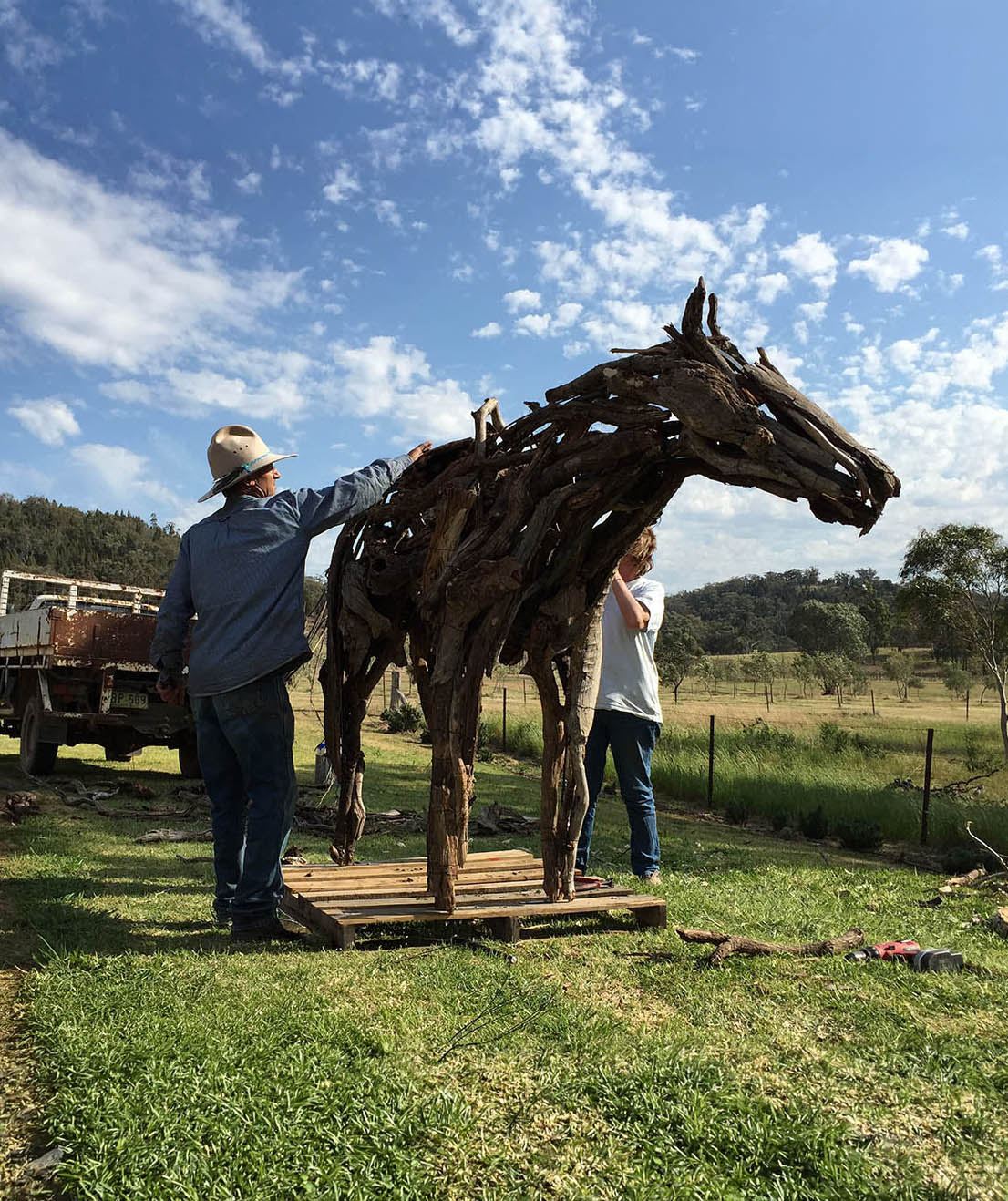
This October, Bert has made his way to Sculptures in the Garden at Rosby Wines & Gallery, where he takes centre stage as the inspiration for our new community sculpture project, My Kingdom for a Horse.
But Bert’s story began many years ago on Stephen’s family property near Walcha.
A Horse with Heart
Stephen broke Bert in when he was around five years old, relatively late for a thoroughbred. Using the Jeffery method, he soon discovered that while Bert wasn’t much of a stock horse, he certainly knew how to run.
Stephen’s great friend and fellow artist, Nigel White, remembers Bert as an exceptionally kind and gentle horse.
In 1991, Nigel travelled to Walcha to ride Bert at the Geebung picnic race meeting.
Bert quickly proved himself the star of the day, winning four heats and heading into the Geebung Cup as the red-hot favourite.
There was just one challenge. Bert was required to carry a staggering 16 stone 12 pounds (approximately 107kg) — a considerable handicap for any racehorse.
It didn’t slow him down.
Bert won the Geebung Cup by three lengths, cementing his place in local racing folklore. Stephen also recalls Nigel winning the Eurapambla Stakes aboard Bert at the same meeting.
As Nigel puts it:
“He was a kind, gentle horse that could gallop!”
And, perhaps even more tellingly, Nigel describes Bert as “the best horse I’ve ever ridden.”
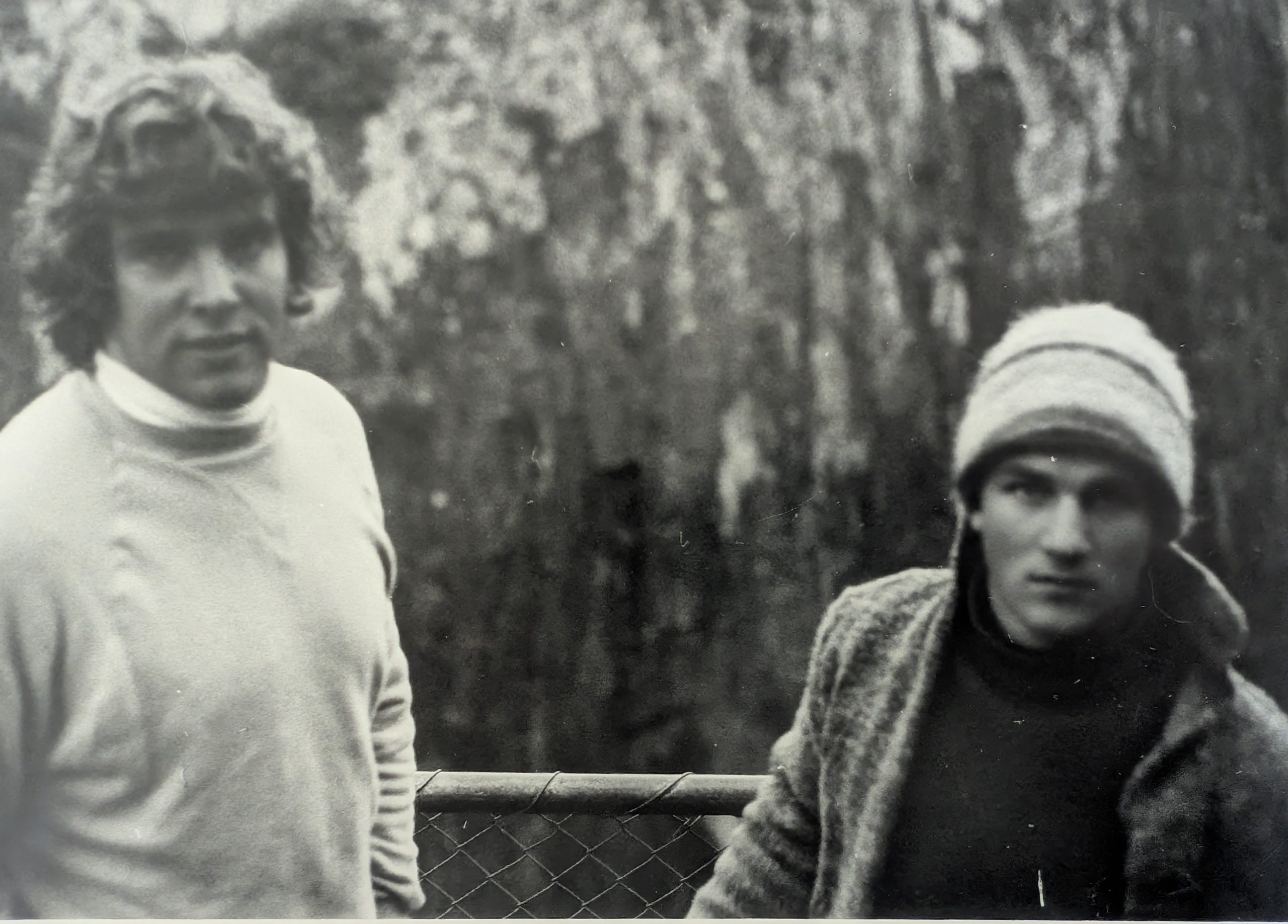
Stephen King & Nigel White
From the Paddock to the Studio
Bert went on to live an extraordinary 40 years — a remarkable age for a thoroughbred.
As he grew older, Stephen noticed that Bert was struggling to maintain his condition. Each winter he would lose weight, and each summer Stephen would work to build him up again. Eventually, though, the weight stopped returning.
Stephen began feeding Bert near his studio so he could keep a closer eye on him.
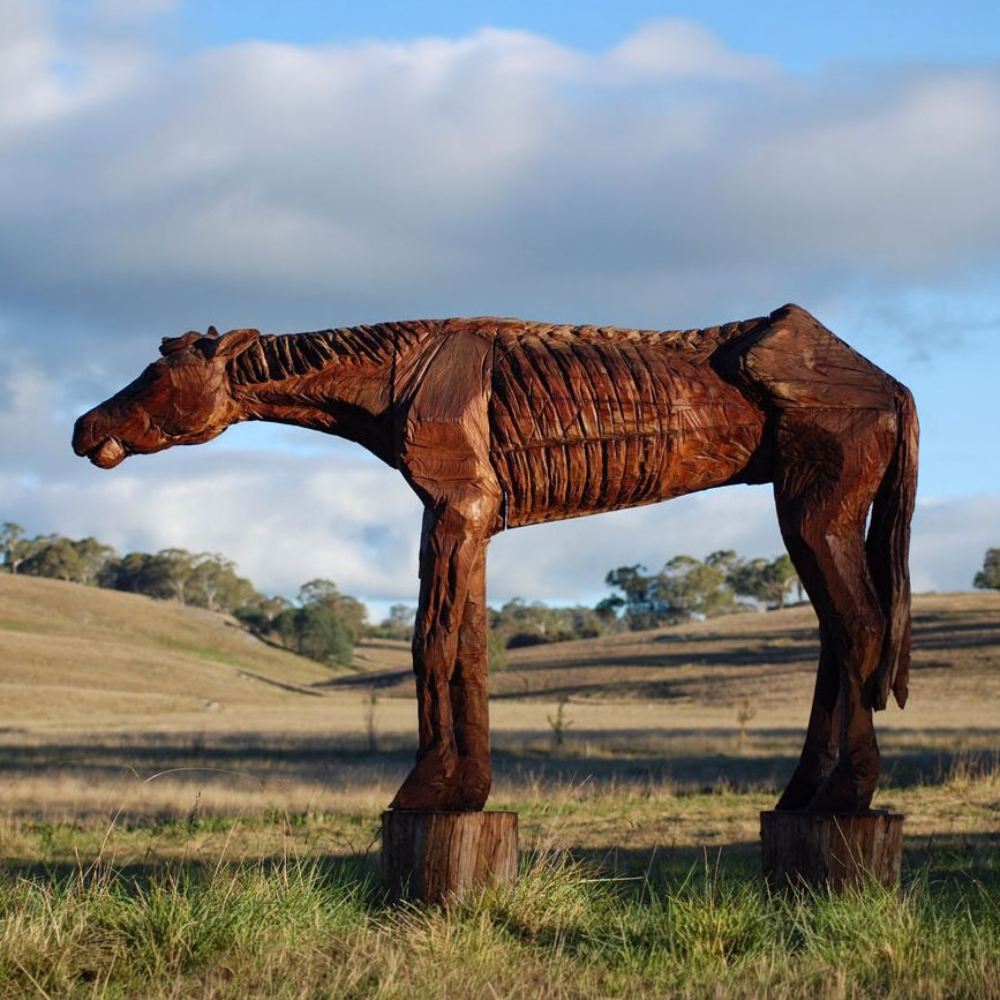
It was during this time that he decided to make a sculpture of his old companion.
With Bert spending his days in the studio yard, Stephen could study him closely — his proportions, stance, anatomy and the character that made him so recognisable.
Unlike many of Stephen’s sculptures, which are carved from a single log, Bert was constructed from at least four separate pieces of locally sourced timber, joined and braced with dowels before being carved into shape.
It was a slow and considered process, with the real Bert never far away.
An Unusual Artistic Process
Sadly, Bert died before Stephen could finish the sculpture.
While Stephen was away, the ageing horse fell in the paddock. When Stephen returned, he found Bert had died.
Wanting to understand what had happened, Stephen carried out an autopsy and discovered a broken rib and bleeding around Bert’s lungs.
He also made another extraordinary discovery.
Bert had an enormous heart — in Stephen’s words, “a heart the size of Phar Lap.”
What happened next is perhaps the most unusual part of Bert’s story.
Determined to complete the sculpture as faithfully as possible, Stephen preserved Bert’s body, eventually hanging him in the shearing shed to dry — much to the disapproval of the workers!
As Bert’s body dried and mummified, Stephen continued studying his anatomy, using this extraordinary reference to finish the sculpture he had begun while his horse was still alive.
What started as a portrait from life had become something much more personal.
More Than a Sculpture
The finished Bert is both a portrait and a memorial — a tribute to a horse that had been part of Stephen’s life for decades.
Stephen also created a smaller, intimate companion work titled Hello Mate, commemorating his old friend.
Together, these works tell a story of friendship, rural life, horsemanship and the close relationship between an artist and the animals that share his world.
And while the process behind Bert might be unconventional, it speaks to Stephen’s deep understanding of anatomy, form and the natural materials he works with.
Bert Comes to Sculptures in the Garden
This year, Bert has travelled to Mudgee to become part of Sculptures in the Garden 2026, bringing his remarkable story with him.
He also has a very special role in our new community sculpture project, My Kingdom for a Horse.
Inspired by Stephen King and the form of the horse, the project invites visitors, artists, school groups and volunteers to work together over the 16 days of the exhibition to create a growing herd of life-sized stick horses.
With Bert standing proudly nearby, participants can study the structure, proportions and character of a horse as they add locally gathered sticks and branches to the growing herd.
It’s a fitting new chapter for Bert — a horse whose life inspired one sculpture, now helping inspire many more.
The completed herd will go on to become public art across the Mid-Western Region, creating a lasting legacy from this year’s exhibition.
And Bert May Still Have the Last Word…
Stephen has one final thought about his old mate.
After everything Bert went through — including the rather unconventional afterlife in the shearing shed — Stephen jokes that he worries about eventually arriving at the pearly gates and finding Bert waiting there for him.
We suspect Bert might have a few things to say.
Come and meet Bert at Sculptures in the Garden 2026.
10–25 October 2026
Open daily, 10am–4pm
Rosby Wines & Gallery, Mudgee
Discover Bert, explore more than 280 sculptures and join us in creating the herd for My Kingdom for a Horse.
My Kingdom for a Horse has been assisted by the Australian Government through the Festivals Australia program.